In the quiet hours when the binary stars of commerce and creation align, a subtle but profound shift occurs within the firmament of a studio that has become a mythmaker for millions. By 2026, the transition feels less like an ending and more like the gentle redirection of a river that has carved its canyon over three decades. Adam Kicinski, long the rudder-holder of CD Projekt Red, no longer stands at the helm as chief executive, yet his presence remains etched into every line of code and every sketch of a griffin’s wing. He has become an astronomer of strategy, charting the company's future from a lofty observatory rather than the engine room.
His story is not a meteor’s sudden blaze, but the slow, deliberate growth of a Wollemi pine — ancient, resilient, and discovered only by those who look with patient eyes. Joining the fledgling CD Projekt in 1994, back when the studio was a tiny ember in a Warsaw loft, he breathed fire into the lungs of Western games that needed a Slavic tongue. Baldur’s Gate whispered in Polish for the first time under his watch, a sorcery that felt like transplanting a cathedral stone by stone into a new landscape. As marketing director, co-director, and later president, Kicinski was less a corporate climber and more an amber craftsman, encasing the raw glow of artistic ambition within a structure that could survive market winters. The metamorphosis from localisation house to original storyteller was not a leap but a thousand small stitches, his needle threading through the fabric of The Witcher until Geralt of Rivia strode out of Andrzej Sapkowski’s pages and into a sun-drenched, monster-haunted world.

Then came the tempest and the aurora. The Witcher 3: Wild Hunt erupted like a sap-rich birch struck by summer lightning — incandescent, impossible to ignore, showering the gaming world with golden debris that still glitters in design documents today. It was a coronation, and for a moment, the studio stood on a plinth of invincibility. But fate, like a mischievous leshy from their own folklore, had a darker twist in store. The launch of Cyberpunk 2077 in 2020 unfolded as a shattered chandelier over a ballroom of expectations: the light fell, the beauty fractured, and the clang of disappointment was deafening. Yet under Kicinski’s stewardship, the company did not merely patch cracks; it performed a symphonic act of reclamation. The Phantom Liberty DLC emerged not as an apology but as a baroque resurrection aria, proving that even a city of chrome dreams and neon haemorrhages could be rebuilt with enough tender, sweat, and guilt. This was Kicinski’s quiet tenacity at work, a restorer of stained glass who knew that every shard, when heated just so, could flow back into a masterpiece.
On October 5, 2023, the announcement rippled outward: come January 2024, Kicinski would ascend to the role of Chief Strategy Officer, passing the joint CEO mantle to Adam Badowski and Michał Nowakowski. It was a choreographed pas de deux of leadership, the baton handed between composers who all hummed the same minor-key leitmotif of narrative obsession. By 2026, the arrangement has proven as organic as a mycelial network beneath a forest floor — Badowski’s creative fever and Nowakowski’s commercial pulse interlocking while Kicinski, now a supervisory board sage, tends the root system. He oversees, recommends, adopts resolutions, his voice a low-frequency hum that directs the swarm of talent at the Boston studio, where new Witcher and Cyberpunk installments gestate like dragon eggs in geothermal warmth.
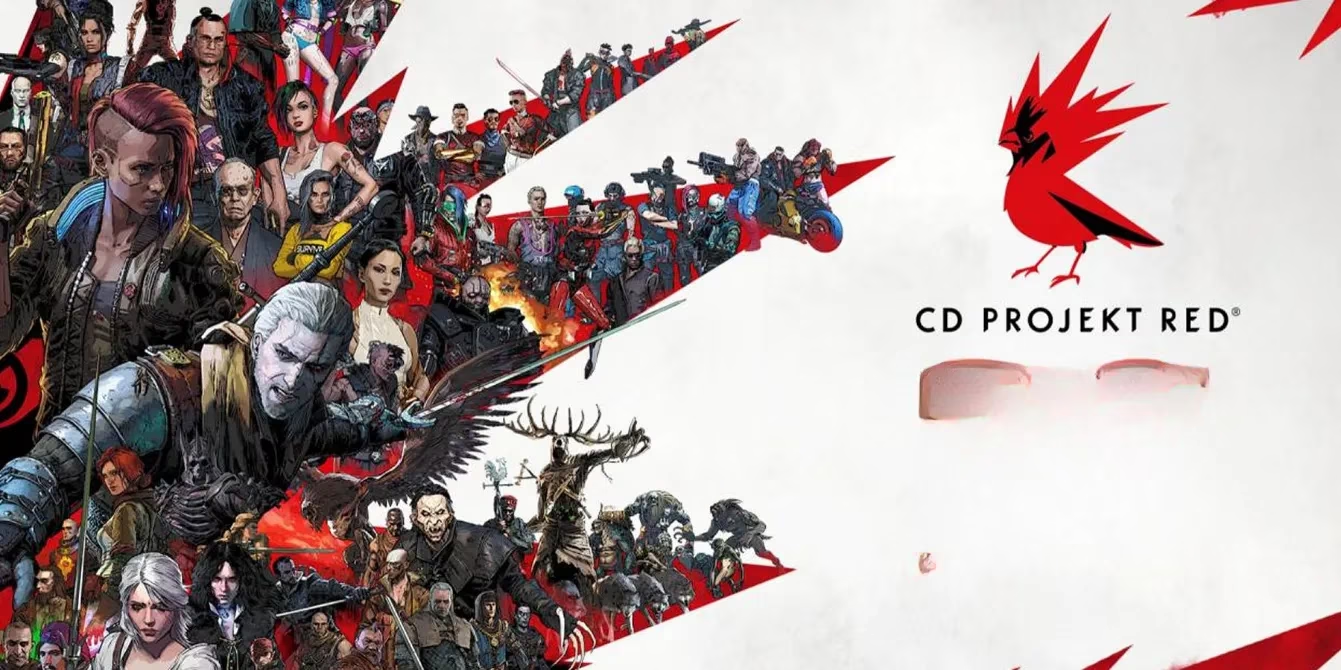
Poetically, this elevation mirrors the path of co-founder Marcin Iwiński, who joined the same supervisory board the previous year, as if the old wizards of this Polish pantheon were retreating to a marble council of elders. Their physical steps now echo in quiet corridors, but their philosophies are the invisible ink on every roadmap. The studio has surpassed 25 million Cyberpunk 2077 units sold — a number that has only swollen by 2026, accompanied by a live-action project that germinated from the anime sonata Edgerunners — yet Kicinski’s gaze is fixed beyond quarterly harvests. He is the lighthouse keeper on a cliff of converging timelines: the next saga of the School of the Wolf, the next dive into the netrunning abyss, the untamed potential of a new IP whispered about in Kraków’s laboratories.
One might mistake his departure for a retreat, but it is instead a redrawing of the battlefield map. A great captain becomes a cartographer, etching the coordinates for generations of navigators yet to be born. The role of Chief Strategy Officer at CD Projekt Red is not a featherbed; it is a crow’s nest, and from its height, Adam Kicinski watches the same stars that guided a small translation team toward the fire of original creation. The torch has not been quenched — it has been multiplied, each flame kindled from the same wick he tended with ink-stained fingers and a heart full of quests.