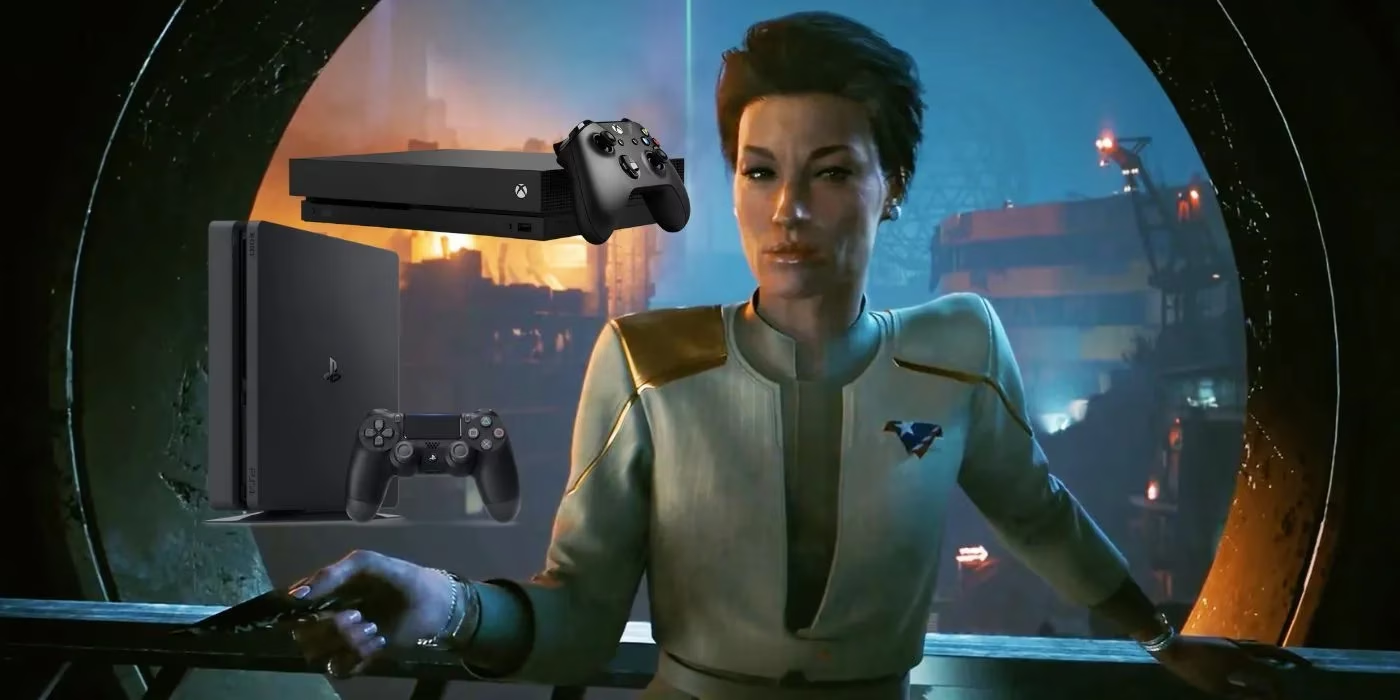
In 2026, my old Xbox One copy of Cyberpunk 2077 sits on the shelf like a ticket stub from a trip I almost took. I was there for the December 2020 launch, and I remember the promise of Night City more vividly than the frame drops, the texture pop-in, and the crashes that turned my first dozen hours into a glitchy fever dream. When Phantom Liberty arrived in September 2023, it looked like the spy-thriller expansion I had been waiting for: a new district, a tense story, and a version of Night City that finally felt alive. But it did not arrive for my machine. That exclusion still feels like a phantom limb: the expansion exists, I can watch it in clips and read about it in patch notes, yet my last-gen console can never touch it.
The Night City That Cracked Under My Feet
I bought Cyberpunk 2077 on Xbox One because that was the console I owned, and because CD Projekt Red made the game sound like it would run on the hardware I had. In practice, the old-gen version ran like a city built on a fault line — every street ready to crack. The 2020 launch was difficult on PC, PS4, and Xbox One, and it was especially rough on the older consoles. By the time the PS5 and Xbox Series X/S versions arrived in 2022, the game had been essentially re-launched with significant improvements. I remember watching comparison videos and feeling a strange mix of relief and resentment: the game I had paid for was finally becoming the game I had imagined, but only if I bought new hardware.
That context matters when I look back at Phantom Liberty. CD Projekt Red announced that the expansion would not be available for the PS4 or Xbox One editions. The game's official site also reported that owners of the Xbox One X — Cyberpunk 2077 Limited Edition Bundle would receive a reimbursement for the expansion in the form of Microsoft Store credits. It was a fair gesture, but it could not erase the larger message: last-gen players were being left behind.
The Expansion That Never Knocked on Last-Gen Doors
Phantom Liberty was designed as the game's only expansion, and CDPR described it as its biggest DLC ever. It followed a spy-thriller story and opened a new section of Night City, and from everything I have seen since 2023, it delivered the kind of focused, cinematic expansion that the base game's rocky launch had made hard to imagine. But the technical scope was also the reason it could not come to PS4 or Xbox One. Trying to pour that expansion into last-gen hardware would have been like trying to pour a supernova into a matchbox: the ambition was simply larger than the container.
The decision was not only about Phantom Liberty. Support for Cyberpunk 2077 on PS4 and Xbox One changed with Patch 1.6 in November 2022. From that point on, the last-gen versions no longer received updates beyond basic technical support, which meant no additional content would be made available for them. In 2026, those versions remain frozen in place while the PC, PS5, and Xbox Series X/S versions have moved on through the 2.0 overhaul and later refinements. The gap is no longer a crack; it is a canyon.
| Platform | Phantom Liberty | Post-Patch 1.6 content | Notes |
|---|---|---|---|
| PC | ✅ | ✅ | Full support and ongoing refinements |
| PS5 / Xbox Series X/S | ✅ | ✅ | Full support and ongoing refinements |
| PS4 / Xbox One | ❌ | ❌ | Frozen after Patch 1.6; basic technical support only |
Why the Cut Was Necessary
As a player, I hated the cut. As someone who has watched game development from the outside, I understand it. CDPR needed to focus its teams on making Phantom Liberty as high quality as possible for the systems it would release on. The 2020 launch had already burned trust, and repeating that disaster with an expansion would have been self-destructive. By limiting the expansion to PC and newer consoles, CDPR could aim for a polished release rather than a compromised one. In 2026, that bet looks like the right call: Phantom Liberty has settled into the conversation as one of the strongest expansions of its generation, and the base game's reputation has been largely rebuilt.
But understanding the choice does not make my old save file feel less strange. My old console became a magician's cabinet with a false back: the expansion was real, but the compartment would never open for me. I could see the new district in trailers, read about the new characters, and watch other players vanish into a story I could not follow. It was like standing outside a club with the bass rattling the pavement, knowing the door would never open.
What 2026 Looks Like Now
Three years after Phantom Liberty launched, the expansion is no longer a question mark. It is a finished chapter. CDPR has confirmed that it is the only expansion for Cyberpunk 2077, and the studio's focus has shifted toward the next Cyberpunk project. For last-gen owners, the practical reality is simple: if you want Phantom Liberty, you need a PC, PS5, or Xbox Series X/S. The reimbursement for the Xbox One X Limited Edition Bundle was a courteous ending, but it was still an ending.
I still love Night City. I still think about the promise of that first trailer and the mess of that first launch. But when I look at my old copy of Cyberpunk 2077, I do not see a failure anymore. I see a bridge that ends mid-span: the road was real, the destination was real, and the gap was real too. Phantom Liberty was the expansion that finally gave many players the Cyberpunk story they wanted, and in 2026 I can appreciate it from a distance — even if my last-gen console never got to cross over.
This overview is based on Digital Foundry, whose technical reporting helps explain why Cyberpunk 2077 eventually split between generations: the demands of denser city simulation, steadier frame rates, and broader systemic upgrades made last-gen compromises harder to justify, reinforcing the idea that Phantom Liberty was built for hardware with more headroom rather than for machines already strained by the base game.