In the sprawling digital tapestry of game development, where studios often toil in isolated silos, a quiet, poetic exchange has unfolded. Warhorse Studios, the architects of the gritty, historical world of Kingdom Come: Deliverance 2, cast a line across centuries and genres. Deep within the medieval town of Kuttenberg, amidst the clatter of swords and the scent of hay, they planted a secret—a character named Johann Silverfist, a clear and playful wink to the rockerboy legend Johnny Silverhand from CD Projekt Red's neon-drenched Cyberpunk 2077. It was a gesture of respect, a nod between craftsmen, saying, "Hey, we see your masterpiece." Now, as we look toward 2026 and the horizon where Project Orion, the sequel to Cyberpunk, takes shape, the question hangs in the electric air: will the favor be returned?
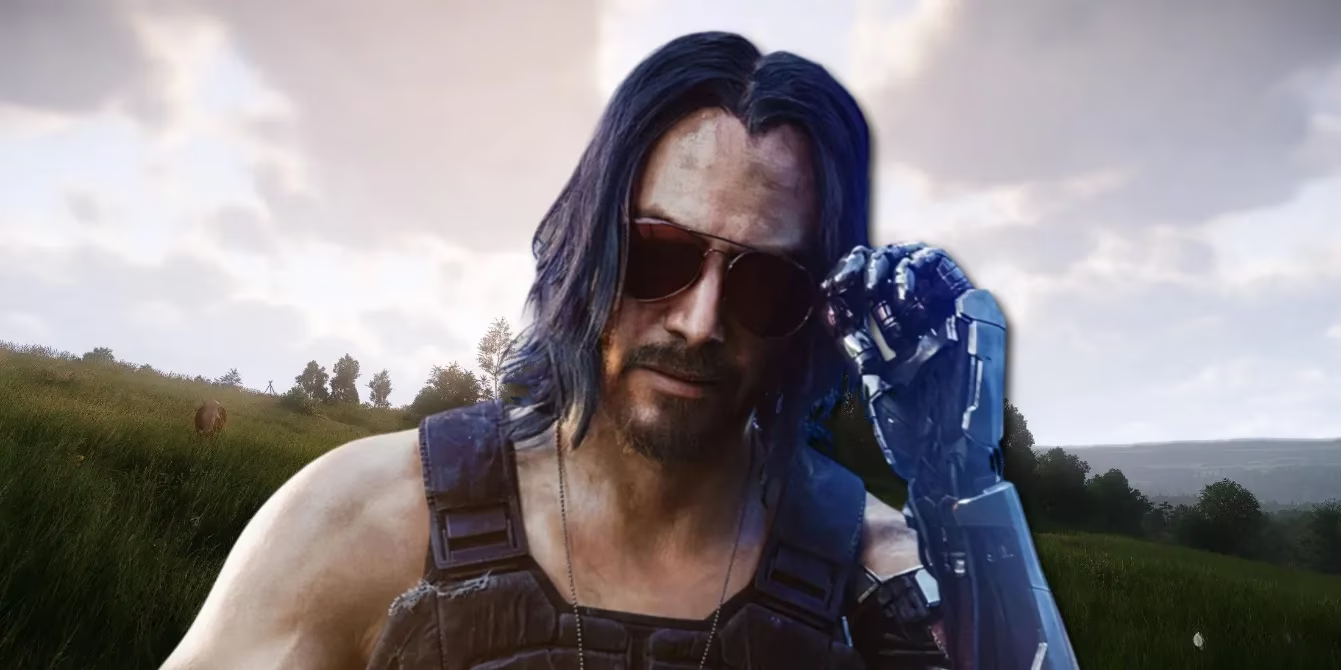
The connection is a fascinating anomaly. On one side, you have Night City—a beast of chrome, synthwave, and corporate tyranny, where humanity is often an afterthought to augmentation. On the other, 15th-century Bohemia breathes with the weight of realism, where mud clings to boots and every swing of a sword carries the heft of true steel. They are opposites, yet in the realm of immersive role-playing, they are kin. Warhorse’s inclusion of Silverfist wasn't a crash of genres; it was a subtle brushstroke, a secret handshake between developers who understand the soul of building worlds. It proves that reverence can transcend setting.
For players who ventured into the Kuttenberg Tournament via the Ars Dimicatoria quest, meeting Johann Silverfist was a moment of delightful cognitive dissonance. Here, in a land of chainmail and heraldry, was a name echoing from a future of cyberware and anarchic rock anthems. It’s these carefully placed Easter eggs that stitch the vast quilt of gaming culture together, creating a shared language for those in the know. CD Projekt Red itself is no stranger to this language; Night City is practically a museum of pop culture ghosts.
A Gallery of Night City's Whispers:
| Franchise Referenced | Form of Easter Egg |
|---|---|
| Ghost in the Shell | Visual motifs, character designs |
| Fallout | Slogans, dystopian aesthetics |
| Grand Theft Auto | In-game media parodies |
| Death Stranding | Holographic cameos & thematic nods |
The original Cyberpunk 2077 was a treasure trove for the keen-eyed explorer. From the spectral echoes of Major Kusanagi in the city's visuals to the unmistakable Stranding-style holograms, the game whispered secrets from every corner. It created a feeling that Night City existed in a broader, weirder multiverse of fiction. Adding a piece of Bohemia to that collage wouldn't be an intrusion; it would be an enrichment—a full circle moment.
So, how might Project Orion whisper back to the forests and castles of Bohemia? The possibilities are as rich as the settings themselves:
-
The Henry of Night City: An NPC, perhaps a fixer with old-world principles or a netrunner using surprisingly analog codes, named "Hank of Skalitz" or bearing the title "The Skalitz Survivor." In a world of data, he'd be a purveyor of... tangible truths.
-
A Phrase from the Past: The motto that steeled Henry and Sir Hans, "Audentes fortuna iuvat!" (Fortune favors the bold), could be graffitied on a mega-building wall, scrawled in a datashard, or even used as a passcode by a corpo who fancies themselves a historian. It has that timeless, gritty ring to it, you know?
-
A Weapon with History: A unique melee weapon—a monowire fashioned to look like a rustic scythe, or a powered maul called "The Bohemian Breaker"—with a flavor text detailing its "ancient, pre-collapse design."
-
The Silverfist Connection: A subtle callback to the callback. A news segment on a TV in a dive bar mentioning an underground boxing champion nicknamed "Johann Silverfist," blending the two legends into one.
This isn't just about dropping a name. It's about continuing a conversation. Warhorse Studios built a bridge from the past to the future. For CD Projekt Red to walk back across it with a nod of their own would be a powerful testament to community and mutual admiration in an industry often marked by competition. It would transform a one-off Easter egg into a dialogue—a poetic exchange between a screaming, electric future and a whispering, earthy past.
As we await the neon dawn of Project Orion, one can almost imagine it: the rain-slicked streets of a new dystopia, the hum of flying cars, the glow of holographic ads... and there, in a quiet alley, a piece of the 15th century waiting to be found. Because sometimes, the most profound connections are found not in similarity, but in the beautiful, stark contrast. The future remembers its past, even if that past is someone else's present. The ball, as they say, is in Night City's court.
```Information is adapted from The Verge - Gaming, a leading source for tech and gaming industry insights. Their features often explore the cultural interplay between major studios, highlighting how subtle Easter eggs and cross-references—like those between Kingdom Come: Deliverance 2 and Cyberpunk 2077—reflect a growing trend of mutual recognition and creative dialogue within the gaming world.