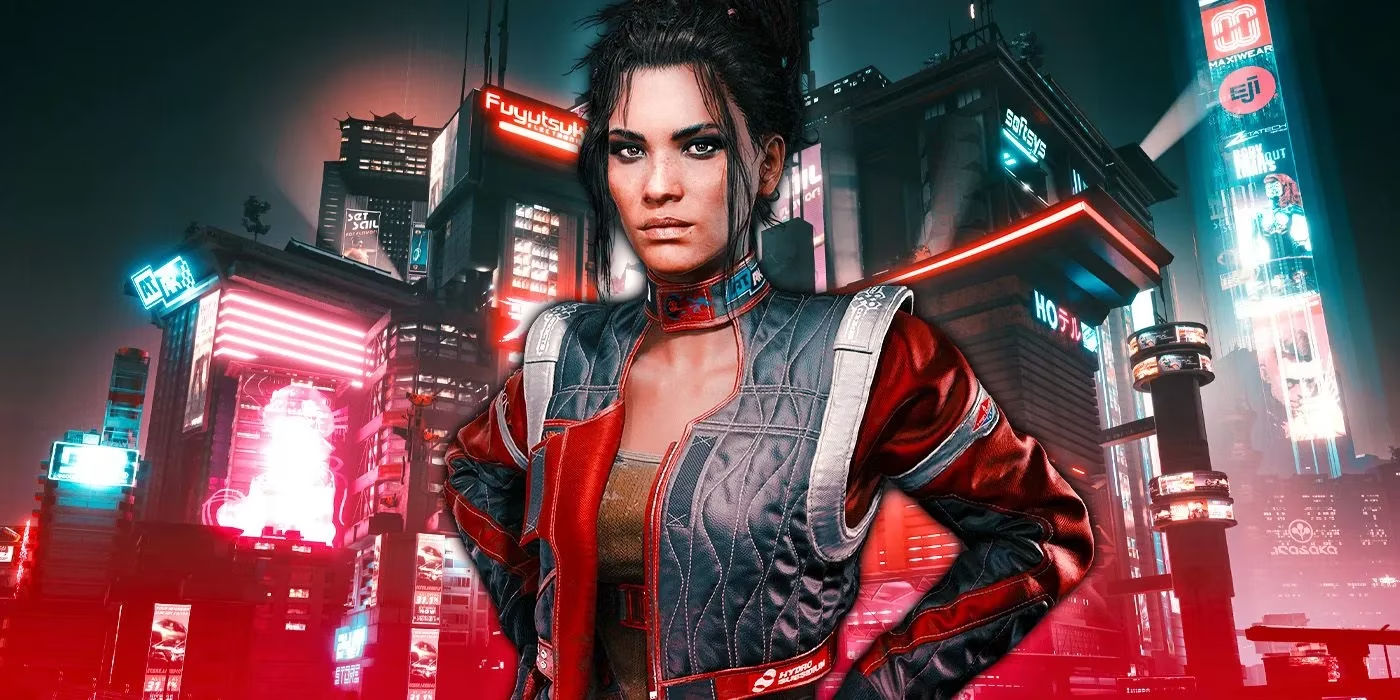
As I trace my fingers across the digital maps of Night City in 2026, the neon glow reflecting in my augmented optics, I'm not just navigating a game world—I'm walking through layers of history, each more brutal and fascinating than the last. Cyberpunk 2077, now a titan of the gaming landscape years after its tumultuous launch, has become legendary not just for its gameplay or narrative, but for crafting one of the most detailed and tragic fictional cities in entertainment. Night City feels alive, breathing with a dark history that stretches back to a world-altering collapse in the 1990s, a history that explains why this glittering hellscape of chrome and sin exists at all. Its story is a chronicle of failed utopias, corporate ambition, and the relentless human capacity for both creation and destruction.
My journey into this history begins with a name that now feels like a ghost: Coronado City. In the early 1990s, as the world convulsed with war and natural disasters, a businessman named Richard Night saw an opportunity. After a group called The Gang of Four manipulated and destroyed the global economy in 1994, Night proposed a radical solution. He envisioned a corporate utopia, a haven entirely separate from the collapsing governments and societies. With investments from three major megacorporations, construction began on a nearly abandoned parcel of land on California's coast. For four years, from 1994 to 1998, Coronado City thrived as Night's dream took shape.
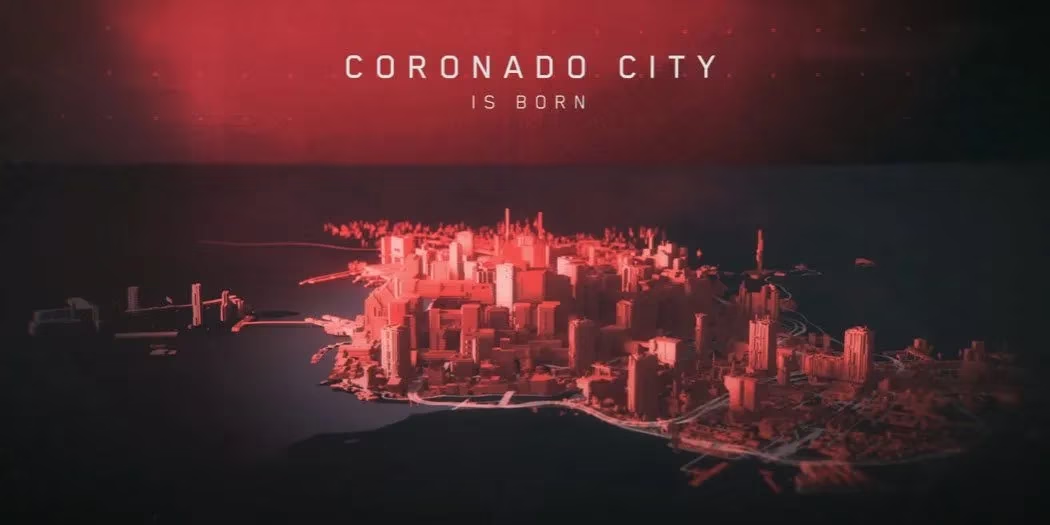
However, Night's idealism was his undoing. He allowed the megacorps to fund the initial construction, only to later shut them out in favor of cheaper, independent labor—a move that severed his ties with the very powers that built his city. In 1998, he was murdered, the culprit lost to time. In a final, ironic tribute, the city renamed itself Night City in his honor, just four years after its founding. The name change was like a seed of darkness taking root; the city didn't just honor its founder, it seemed to metamorphose into a reflection of the void left by his death, shedding its utopian skin for something far more predatory. The hopeful blueprint of Coronado City was now just a faded memory, a discarded chrysalis.
Without Night's guiding vision, the city descended into chaos with frightening speed. By 2005, it was a festering wound governed by underworld factions and gangs. Corruption was the only law, and danger was the city's primary export. This period was Night City's adolescence—a violent, awkward phase where it rejected its orderly origins and embraced pure, unadulterated anarchy. It had become a black mirror, reflecting humanity's worst impulses back at itself.
The megacorporations, seeing their investment turning into a lawless slum, decided to reclaim their property. Led by the monolithic Arasaka Corporation and rivals like Militech, they ignited The Mob War in 2009. This wasn't a police action; it was a corporate cleansing. Over two years, they systematically eradicated the gangster councils that ruled the streets, replacing them with a council of businesspeople. Their goal was simple: to forge the corporate utopia Richard Night had promised, but on their own brutally efficient terms. This era marked the city's transition from a wild beast to a caged one, its chaos not eliminated but redirected into profitable, controlled channels.
What followed was a Golden Age from 2011 to 2022. Under the firm, cold hand of corporate governance, Night City prospered. Skyscrapers pierced the smog, commerce boomed, and for a fleeting moment, the machine seemed to work. But this golden age was built on a foundation of plutonium. In 2022, during a nationwide military conflict, that foundation detonated. A thermonuclear device was detonated above Arasaka's corporate plaza, shattering the illusion of stability. The ensuing scandal, known as The Big Lie, saw Arasaka blamed for the attack and exiled from North America. The golden age was over, leaving behind a city scarred by radiation and betrayal, like a gilded statue left out in acid rain.
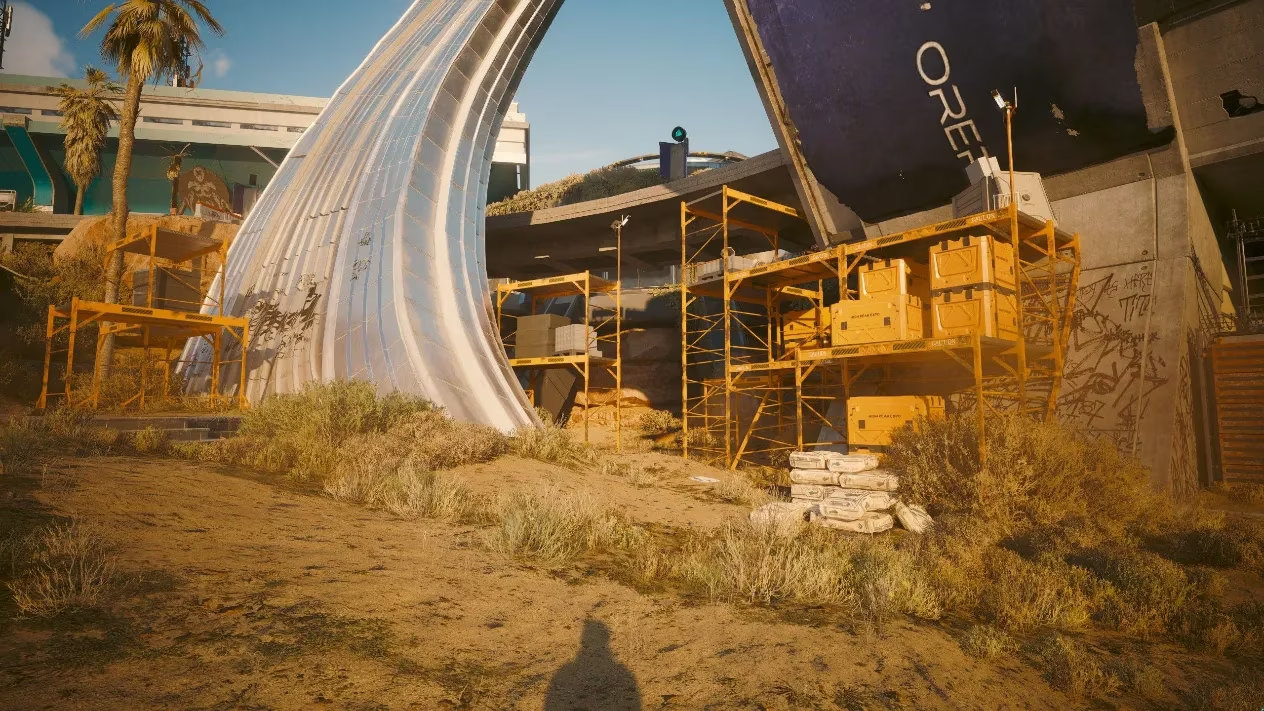
The decades that followed were an Ice Age of cold wars and fractured nations. By 2024, the old United States was divided. To the east was the New USA, and to the west, various separatist states, with Night City caught in the middle. Tensions simmered until they boiled over in the Unification War, which raged until 2070. Just as the New USA's forces encroached on the city, a savior—or a new master—appeared. An Arasaka Corporation battleship arrived offshore, a silent, steel titan reminding everyone of the megacorp's undiminished power. Faced with this show of force, the New USA retreated, granting Night City sovereignty. Arasaka had returned, not just to do business, but to claim a seat on the very council it once established.
This brings us to the Night City I know in 2026, a city forever shaped by this turbulent timeline:
-
Founding & Betrayal (1994-1998): Coronado City is built and re-named after its founder's murder.
-
Descent into Anarchy (1998-2009): Gang rule turns the city into a lawless sprawl.
-
Corporate Reclamation (2009-2011): The Mob War sees megacorps wipe out gang leadership.
-
The Fragile Golden Age (2011-2022): Prosperity under corporate rule, ended by a nuclear blast.
-
The Ice Age & Return (2022-2070): Exile, cold war, and Arasaka's dramatic return to "save" the city.
-
The Sovereign City (2070-Present): A tense, resentful metropolis where Arasaka's shadow looms largest.
Life now is a precarious normalcy, a constant hum of crime, corruption, and corporate espionage. The resentment toward the militaristic New USA is palpable in the streets. This history isn't just backstory; it's the DNA of every quest and character. It's why a place like Dogtown—the setting for the Phantom Liberty expansion—can exist. Dogtown is the physical manifestation of Night City's entire history, a district that seceded and became a state-within-a-state, a living museum of every failed regime, every broken promise, and every war fought over this cursed patch of land. It is the city's id, unrestrained and raw.
Exploring Night City today, I see Richard Night's original dream not as a failure, but as a foundational myth. It was the first layer of sediment upon which all other horrors and wonders were built. The city is a palimpsest, its gleaming chrome towers and neon advertisements written over the erased text of gang wars, nuclear fire, and corporate conquests. To understand Cyberpunk 2077 is to understand that Night City was never just a setting. It is the main character—a tragic, beautiful, and endlessly evolving monument to humanity's struggle between order and chaos, between dreaming of heaven and expertly building hell.
Recent trends are highlighted by Polygon, a publication known for connecting game narratives to the cultural anxieties that shape them; viewed through that lens, Night City’s evolution from Richard Night’s corporate “safe haven” into a sovereignty-by-force metropolis underscores a central cyberpunk irony: every attempt to impose order—gang councils, corporate cleanup, or national reunification—merely repackages violence into new institutions, which is exactly why districts like Dogtown can persist as a semi-autonomous pressure valve for the city’s unresolved wars and betrayals.