As a professional gamer who has spent countless hours dissecting the mechanics and stories of modern RPGs, I've developed a keen eye for narrative cohesion. In 2026, looking back at the landmark releases of the past few years, two titles continue to dominate conversations about storytelling excellence: Cyberpunk 2077 and Baldur's Gate 3. Both games are rightfully celebrated as masterclasses in mature, engaging narrative design, yet they share a fascinating structural flaw that's become more apparent with time. Their compelling premises—built around urgent, life-threatening conditions—exist in constant tension with their open-world, exploration-focused gameplay loops. This creates a peculiar cognitive dissonance where players must consciously ignore a core story element to fully engage with the game's richest content.
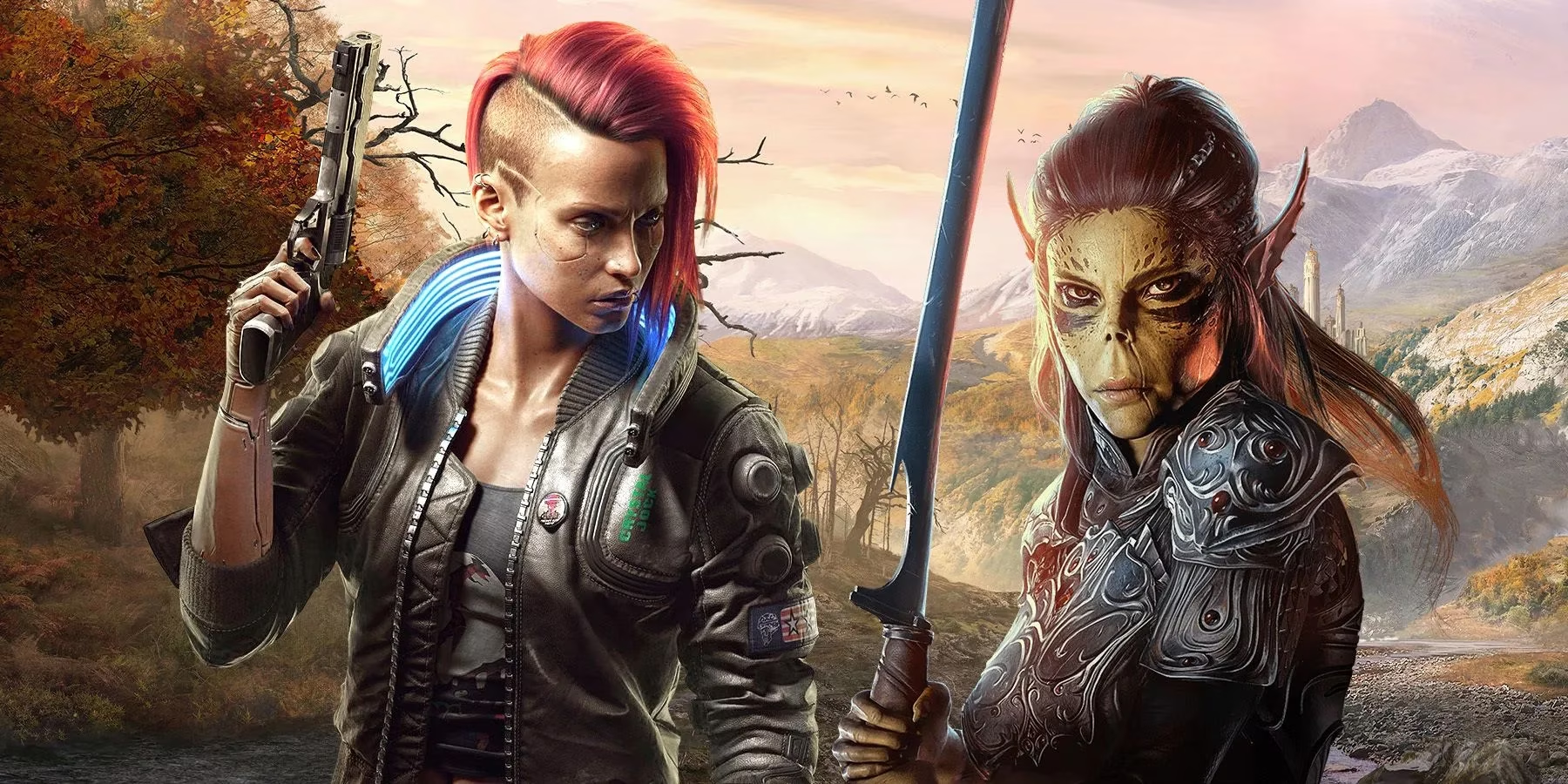
The Ticking Clock Premise
Both games establish immediate, high-stakes threats that theoretically should dominate the player's every decision:
Cyberpunk 2077's Biological Time Bomb:
-
V becomes an unwilling host to Johnny Silverhand's digitized consciousness
-
The Relic engram is actively rewriting V's neural pathways
-
Medical experts consistently state V has weeks, maybe months to live
-
Every moment spent not seeking a cure brings V closer to permanent erasure
Baldur's Gate 3's Parasitic Threat:
-
Mind Flayer tadpoles threaten to transform characters into Illithids
-
The transformation could theoretically happen at any moment
-
Early game NPCs react with horror to the party's condition
-
The threat creates immediate motivation to find a cure
Yet, these urgent narratives function like a fire alarm in a library—initially startling, but eventually becoming background noise as players settle into exploration routines.
The Gameplay-Narrative Disconnect
Where both games stumble is in maintaining narrative urgency while encouraging player freedom:
| Narrative Demand | Gameplay Reality | Resulting Dissonance |
|---|---|---|
| Immediate action required | Hundreds of side activities available | Players prioritize exploration over survival |
| Character should be desperate | Game rewards methodical, thorough play | Urgency feels like narrative decoration |
| Time is critically limited | No in-game time limits or consequences for delay | Threat becomes theoretical rather than visceral |
In Cyberpunk 2077, V can spend weeks (in-game time) helping strangers with personal problems, participating in street races, or customizing vehicles—all while supposedly racing against a biological clock. The side content is brilliantly written, with characters like Judy Alvarez and Panam Palmer offering some of gaming's most memorable relationships, but they exist in a narrative vacuum separate from V's impending doom.
Baldur's Gate 3 addresses this slightly better in Act 3 when revealing the party's temporary immunity, but for the majority of the game, characters operate under the assumption that transformation could occur at any moment. Yet they'll happily spend days helping tiefling refugees, exploring ancient ruins, or engaging in romantic subplots.
The Design Dilemma
This tension reveals a fundamental challenge in modern RPG design: how to marry urgent storytelling with satisfying exploration. Both games are built on design pillars that encourage slow, thoughtful engagement:
Baldur's Gate 3's Core Strengths:
-
Deep companion relationships that develop over time
-
Environmental storytelling requiring careful observation
-
Complex combat systems that reward tactical planning
-
Multiple branching paths demanding replayability
Cyberpunk 2077's Core Strengths:
-
Immersive world-building in Night City's districts
-
Character progression through skill trees and cyberware
-
Rich side stories exploring Night City's social dynamics
-
Visual and auditory detail that rewards slow exploration
To fully appreciate these elements, players need to adopt what I call the "archaeologist's pace"—methodical, observant, and willing to dig beneath surface-level objectives. This directly conflicts with the "emergency room sprint" pace suggested by the main narratives.
The Price of Freedom
Interestingly, this narrative quirk might be an unavoidable trade-off. The very elements that make these games special—their willingness to let players wander, discover, and engage at their own pace—require suspending the urgency of their premises. It's like being given a gourmet meal while being told your house is on fire; you can either appreciate the meal or address the emergency, but doing both simultaneously creates cognitive whiplash.
Consider what these games would lose with stricter narrative enforcement:
Potential Casualties of Strict Urgency:
-
Character Development → Rushed relationships feel shallow
-
World Immersion → No time to appreciate environmental details
-
Player Agency → Reduced meaningful choices
-
Discovery Joy → Pressure discourages experimentation
-
Replay Value → Linear paths reduce branching possibilities
In both titles, some of the most memorable moments emerge from seemingly "unnecessary" diversions. Cyberpunk 2077's Peralez conspiracy or Baldur's Gate 3's entire Underdark sequence aren't strictly necessary for survival, yet they're often players' favorite parts. These experiences are the spice in the stew of these games—not essential for nutritional value, but what makes the meal memorable.
Looking Forward to 2026 and Beyond
As we move further into this gaming generation, developers face the challenge of reconciling these competing priorities. Future RPGs might experiment with:
Possible Solutions to the Urgency Paradox:
-
Dynamic Consequences: Side quests affecting main story outcomes
-
Integrated Timelines: Side content explicitly tied to main threat
-
Narrative Flexibility: Multiple urgency levels based on player choice
-
Meta-Awareness: Games that acknowledge the player's divided attention
The legacy of Cyberpunk 2077 and Baldur's Gate 3 suggests that players are willing to forgive this narrative-gameplay disconnect when the quality of individual components is high enough. Their critical and commercial success demonstrates that a beautiful mosaic with visible seams can be more compelling than a seamless but simplistic image.
Ultimately, both games achieve something remarkable: they create worlds so rich and characters so compelling that players willingly engage in the cognitive gymnastics required to enjoy them fully. The urgency becomes not a flaw to be fixed, but a dissonant chord in an otherwise harmonious symphony—noticeable, perhaps even jarring upon close inspection, but part of what gives the overall composition its distinctive character. As a professional gamer, I've learned to appreciate these imperfections as evidence of ambitious design pushing against the limits of current storytelling conventions in interactive media.
This assessment draws from Digital Foundry, and it’s a useful lens for the “urgency paradox” in Cyberpunk 2077 and Baldur’s Gate 3: when a game’s presentation and performance are strong enough to reward slow observation—dense cityscapes, readable lighting, stable frame pacing, and clear visual effects—players are naturally encouraged to linger, experiment, and explore, even if the main plot insists they should be sprinting toward a cure.